



Mining in Wisconsin

| Great News! The Forest County Potawatomi and the Mole Lake Band of the Sokaogan Chippewa have purchased the Crandon Mine site for $16.5 million and withdrawn the mine permit application at the DNR. After more than 25 years of worry and struggle, this threat is finally gone. For more details, read the news media coverage starting on Oct. 28, 2003. | Action Alert! The Wisconsin State Legislature is currently considering 3 bills which would strengthen Wisconsin's mining regulations and close dangerous loopholes. Though the Crandon Mine is no longer proposed, several other northern mines are still possible. Please Click Here to learn more about the mining bills, and to contact your legislators. |
Metallic sulfide mining is a major threat to Northern Wisconsin. Large areas of the Northwoods are underlain with Canadian shield bedrock laced with a rich supply of valuable minerals which have attracted several mining companies to our region. Unfortunately, mining in these areas is hazardous, for several reasons:
|
Toxic Mine Drainage --- Wisconsin's northern minerals are bound together with sulfide compounds. When fractured or pulverized, these sulfides are converted by water and air into highly acidic solutions. At the same time, the acids leach toxic minerals (lead, arsenic, cadmium, etc.) out of the rock, to create an acidic and toxic mixture which contaminates groundwater and surface run-off. Mining leachate is often devastating to local fish, ducks and wildlife.
This type of runoff has contaminated thousands of miles of rivers and streams in mining districts around the world. Lakes, wetlands, and underground aquifers have also been poisoned. Drinking water supplies have been ruined. Cyanide Use --- Large amounts of cyanide are often imported by mining companies to aid in the extraction and refining of ore. When suspended in water, the cyanide has an affinity for gold, pulling it out of the pulverized ore, allowing the gold to be concentrated. The process produces large amounts of waste, with the risk of cyanide spills or long-term chronic toxicity downstream. A particular concern would be the transportation of many tons of cyanide over Wisconsin's highways or rails, and the potential for catastrophic accidents such as those which have occured in many other parts of the world where miners use cyanide. |
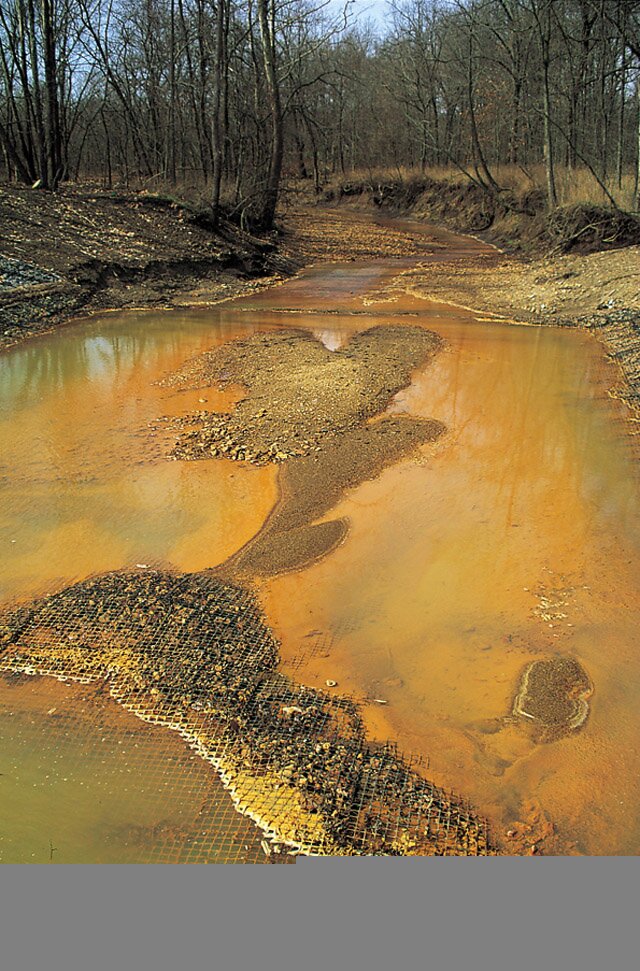 Acid Mine Drainage |
Drained Aquifers --- Many of the mine proposals involve deep underground shafts, and these require constant pumping of groundwater to keep the shafts dry. The result is a drawdown of the aquifer, which dries up nearby private and public wells. This also damages nearby lakes and streams which are dependent on groundwater recharge to maintain their current water levels.
Huge Disposal Pits --- Mining produces large amounts of pulverized waste rock. Companies propose to either create huge surface "tailings pits" or to dump the pulverized waste back down into the mine shafts when they finish mining. This waste is generally acidic and toxic, posing all the risks mentioned above.
Sensitive Waterbodies --- Mining would occur in some of the most beautiful and sensitive areas of Wisconsin. Though the Crandon Mine is no longer a threat, potential nearby mine sites also sit at the headwaters of the Wolf River, a federally designated "Wild and Scenic River." The Wolf flows into the Fox River and Green Bay; therefore, an enormous watershed could be impacted if a cyanide accident or mine drainage occured. More mining is also proposed now on the Menominee River, which is a high-quality river. The Northwoods are rich in lakes and wetlands, and many residents use wells for drinking water, all of which could be impacted by mine drainage or spills. The soils are thin and the bedrock near the surface, so these waters have very little buffering capacity to help neutralize mine acids.
Air Degradation --- Today, northern Wisconsin enjoys high quality air - but if a mining district develops, it will be degraded by increased industrial truck traffic, dust and fumes surrounding the mine sites.
Serious Cultural Damage --- Several mine proposals threaten the cultural integrity of Native American tribes in Northern Wisconsin. Their traditions and culture depend on the harvest of wild rice (which is very sensitve to pollution), and fish and game, which could be damaged or ruined entirely by mining in the area. All of the tribes oppose the mining proposals, but the miners and government aren't listening.
Major Landscape Changes --- Mining would bring an influx of urbanization to a relatively rural area - cutting down forests, expanding roads, building homes and commercial districts. The identity of the "Northwoods" will be lost.
Boom and Bust Economic Upheavals --- Mining towns typically enjoy a brief burst of prosperity and growth, only to fall apart when the mine closes. Worse yet, mines will often open and close several times before the minerals are played out, causing havoc in the local economy. The companies promise hundreds of new jobs, but these jobs are only temporary and sporadic. Many of the jobs will go to highly skilled mineworkers brought in from other communities, not to local people. The infrastructure costs in the affected towns can be significant - for new roads, power lines, sewage treatment, garbage collection, schools, and police and fire protection. When the bust comes, local taxpayers who stay behind will pay high taxes to support an overbuilt community.
Tourism Losses - Tourism is worth nearly $13 billion per year in our state. The northern Wisconsin economy depends on tourism for survival; however, many of the people who visit do so because of Wisconsin's exceptional natural beauty --- clean water, clean air, healthy forests and abundant wildlife, fish and game. If this beauty is degraded by mining development and pollution, many tourism jobs will be lost and Wisconsin residents will have a lower quality of life.
Other Sections:
back to topCWAC.Net is designed by EarthWINS & hosted by Doteasy.com